
Blog Details
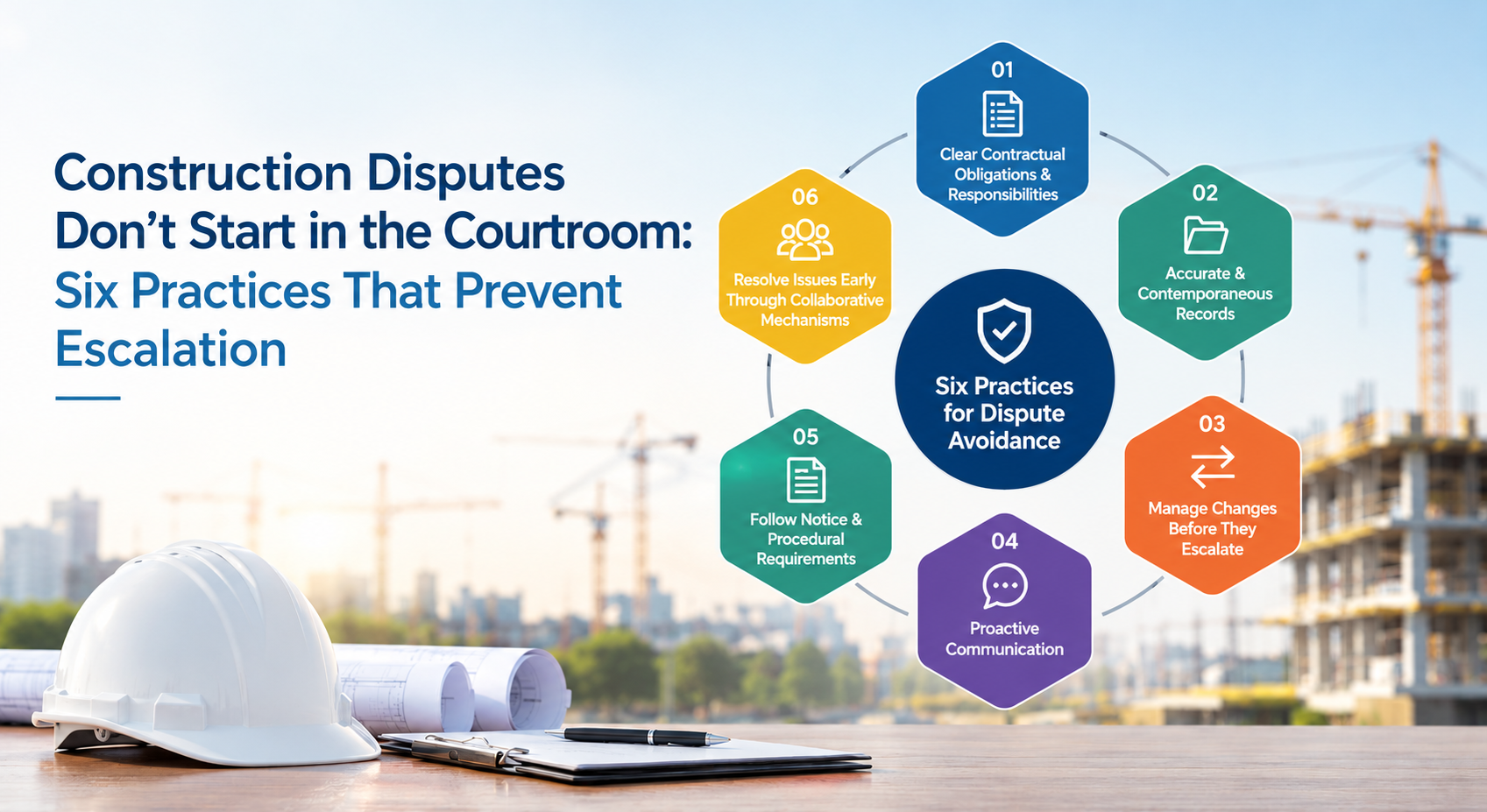
Construction Disputes Don't Start in the Courtroom: Six Practices That Prevent Escalation
Effective dispute avoidance is not simply about resolving disagreements. It is about creating the project controls, contractual discipline and communication practices that prevent manageable issues from becoming costly disputes.
Construction disputes rarely emerge from a single event. More often, they develop gradually through a series of unresolved issues: unclear contractual responsibilities, delayed notices, incomplete records, unmanaged variations, conflicting interpretations and communication breakdowns.
At the beginning, these issues may appear manageable. A delayed approval, a disputed instruction or an unrecorded change might seem like a routine project challenge. However, when such matters remain unresolved, their consequences can accumulate. Time and cost impacts become harder to establish, contractual positions begin to diverge, and working relationships deteriorate.
By the time a disagreement becomes a formal claim or dispute, the underlying problem may have been developing for months.
Effective dispute avoidance is therefore not simply about resolving disagreements. It is about creating the project controls, contractual discipline and communication practices that prevent manageable issues from becoming costly disputes.
For project owners, contractors, consultants and EPC stakeholders, this begins with six fundamental practices.
- Keep Contractual Obligations and Responsibilities Clear
A construction contract establishes the framework within which a project operates. It defines responsibilities, procedures, risk allocation, payment mechanisms, time obligations and the processes for managing change.
Yet contractual provisions can be interpreted differently by different stakeholders, particularly when responsibilities overlap or project requirements evolve.
For example, if the responsibility for obtaining a design approval is unclear, a delay may affect procurement, construction sequencing and completion milestones. Each party may then develop a different understanding of who was responsible and whether an entitlement to additional time or cost exists.
Preventing such situations requires more than signing a contract. Teams must understand the obligations that affect their work.
Responsibility matrices, contractual obligation registers, approval workflows and regular contract reviews can help establish accountability. When an ambiguity arises, it should be clarified through the appropriate contractual process rather than left to informal assumptions.
- Maintain Accurate and Contemporaneous Project Records
When a project issue becomes contentious, recollections and verbal explanations rarely provide a sufficient basis for establishing what happened.
Reliable records help reconstruct events, assess causation and understand the resulting consequences.
Depending on the project, relevant records may include daily site reports, progress updates, programmes, meeting minutes, correspondence, instructions, inspection reports, resource records and cost information.
Consider a contractor experiencing delayed access to a work area. Without reliable records showing when access was required, when it was provided, what activities were affected and what mitigation was attempted, it may become difficult to establish the actual impact.
Records should be created as events occur, not reconstructed months later when a claim emerges.
The objective is not to generate paperwork for its own sake. It is to maintain an accurate, traceable account of project events that supports sound decisions and objective contractual assessments.
- Identify and Manage Changes Before They Escalate
Changes are an inherent part of construction projects. Design revisions, additional instructions, scope modifications and unforeseen site conditions can affect resources, sequencing, cost and completion dates.
The risk increases when changes are implemented without clearly documenting their scope, authority, commercial implications or time consequences.
An instruction may initially appear minor but later affect procurement commitments, work sequencing or critical project activities. If the change is not assessed promptly, disagreement may arise over whether it was authorised, how it should be valued and whether additional time is justified.
A disciplined change management process should capture the instruction, establish its contractual basis, assess potential time and cost impacts, and maintain the necessary approvals and records.
Importantly, identifying a potential impact does not automatically establish entitlement. The relevant contract provisions, evidence, causation and applicable procedures must still be assessed.
Early evaluation gives stakeholders a better opportunity to understand consequences before positions become entrenched.
- Communicate Risks, Concerns and Impacts Proactively
Communication failures often turn technical or commercial issues into relationship problems.
When a stakeholder becomes aware of a potential delay, resource constraint, design conflict or access issue, communicating it early allows other parties to investigate the cause and consider practical responses.
By contrast, delayed communication can leave stakeholders with fewer options and increase the likelihood of competing explanations.
Effective communication should be factual, timely and specific. It should identify the issue, explain its potential consequences, establish what information is required and clarify the action needed from relevant parties.
Regular progress meetings, risk reviews and documented action registers can support this process.
Proactive communication does not mean conceding contractual rights or accepting responsibility prematurely. It means ensuring that relevant facts are shared through appropriate channels so that issues can be managed before they become more difficult to resolve.
- Follow Contractual Notice and Procedural Requirements
Even when a project team recognises a genuine problem, failure to follow the applicable contractual procedures can create additional complications.
Construction contracts may prescribe requirements for notices, claims submissions, supporting particulars, assessments and responses. The wording, timing and consequences of these requirements depend on the governing contract and applicable law.
Teams should therefore understand the specific notice provisions relevant to delays, variations, payment issues and other potential claims.
A practical approach includes maintaining a notice register, assigning clear responsibilities, monitoring deadlines and retaining evidence of submission and receipt.
Contractual notices should not be treated as administrative formalities to be addressed only after a dispute develops. They are part of the contract's risk management framework.
Where an issue arises, the relevant provisions should be reviewed promptly, and appropriately qualified contractual or legal advice should be obtained when necessary.
- Resolve Issues Early Through Structured, Collaborative Mechanisms
Not every disagreement needs to become a formal dispute.
Many issues can be addressed through timely technical reviews, commercial discussions, joint assessments and structured escalation procedures. The key is to establish a process that allows the parties to examine evidence, understand their respective positions and evaluate possible solutions.
For example, a disagreement about delay responsibility may benefit from a review of the accepted programme, contemporaneous updates, relevant events, critical path effects and mitigation measures.
This creates a more objective basis for discussion than relying on competing assertions.
Early resolution does not require parties to abandon legitimate contractual entitlements. Instead, it encourages them to assess those entitlements fairly while practical options remain available.
Where informal discussions are unsuccessful, the contract's prescribed dispute resolution mechanisms should be followed.
At Al Qarar Group, we believe that strong contract administration, disciplined project controls and proactive commercial management are fundamental to effective dispute avoidance. By connecting project events with contractual obligations, causation, time impacts and financial consequences, stakeholders can make more informed decisions and strengthen their approach to claims management.
Because the most effective dispute strategy often begins long before a dispute exists.
These six practices work best when they operate together. Clear responsibilities establish accountability. Accurate records preserve the facts. Effective change management identifies consequences. Proactive communication creates opportunities to respond. Contractual compliance protects procedural positions. Structured resolution helps prevent unresolved issues from escalating. Together, they create a project environment in which decisions are supported by evidence and emerging risks can be addressed systematically. The goal is not to eliminate every disagreement. Construction projects involve multiple stakeholders, complex dependencies and competing commercial interests. Differences of opinion are inevitable. The real objective is to identify disagreements early, manage them transparently and resolve them before they unnecessarily affect project time, cost, relationships and delivery.
Want More Insights?
Explore more articles, case studies, and expert perspectives to stay ahead in AI, data, and digital transformation.
Back to Blogs