Blog Details
The Critical Role of Records and Communication in Project Resilience
Maintaining accurate, contemporaneous records is one of the most powerful tools in project management, especially during uncertain times. These records act as a factual timeline of events, helping teams track what happened, when it happened, and what impact it had.
In times of uncertainty, projects are tested not just by execution challenges, but by how well they are documented and communicated. While delivery, timelines, and cost control remain critical, it is often the discipline behind records and communication that determines whether a project withstands disruption or struggles because of it.
Uncertainty can arise from multiple sources: shifting market conditions, supply chain disruptions, regulatory changes, or unforeseen external events. These factors can quickly impact schedules, budgets, and overall performance. In such situations, focusing only on execution is not enough. What becomes equally important is capturing events as they happen and communicating them clearly within the contractual framework.
The Role of Real-Time Documentation
Maintaining accurate, contemporaneous records is one of the most powerful tools in project management, especially during uncertain times. These records act as a factual timeline of events, helping teams track what happened, when it happened, and what impact it had.
Effective documentation helps to:
- Preserve contractual entitlement by establishing clear cause-and-effect relationships
- Strengthen transparency across all stakeholders
- Support faster, more informed decision-making
- Create a reliable audit trail for future reference
- Reduce ambiguity in case of disagreements or claims
Without proper documentation, even valid claims may lack credibility. On the other hand, disciplined record-keeping provides clarity and confidence in both internal and external discussions.
Why Contractual Communication Matters
Equally critical is proactive and timely contractual communication. Most contracts include specific provisions requiring formal notices for delays, variations, or disruptions. These are not just administrative formalities; they are essential mechanisms for risk management.
Proactive communication ensures:
- Risks are formally recognized and acknowledged
- Stakeholders are aligned on evolving project conditions
- Contractual rights are protected through timely notices
- Issues are addressed early before they escalate into disputes
- A structured framework exists for managing changes
Failing to communicate on time can lead to serious consequences, including loss of entitlement or weakened negotiating positions. Clear and timely notices create a shared understanding and enable all parties to respond appropriately.
Disruption Is Inevitable—Mismanagement Is Not
It is important to understand that projects do not suffer only because disruptions occur. In complex environments, disruptions are often unavoidable. What truly impacts project outcomes is how these disruptions are managed.
Projects typically face challenges when:
- Events are not properly recorded
- Impacts are not clearly assessed or substantiated
- Contractual notices are delayed or missed
- Communication between stakeholders is inconsistent or unclear
In contrast, projects that maintain discipline in documentation and communication are better equipped to handle uncertainty. They can respond faster, justify decisions, and maintain alignment among stakeholders.
Enabling Better Decision-Making
In uncertain environments, decisions often need to be made quickly and under pressure. Having access to accurate, up-to-date information allows project teams to evaluate risks, explore alternatives, and make informed choices.
Disciplined practices enable:
- Proactive rather than reactive decision-making
- Better risk assessment and mitigation planning
- Greater confidence in strategic and operational decisions
This not only improves project outcomes but also strengthens stakeholder trust.
A Safeguard Against Future Disputes
Many project disputes do not arise from the disruption itself, but from a lack of clarity around what happened. Differing interpretations, missing records, and delayed communication often lead to conflicts.
Strong documentation and communication practices:
- Provide a clear factual basis for discussions
- Minimize misunderstandings and misinterpretations
- Support faster and more amicable resolution of issues
- Reduce the likelihood of costly legal disputes
Conclusion
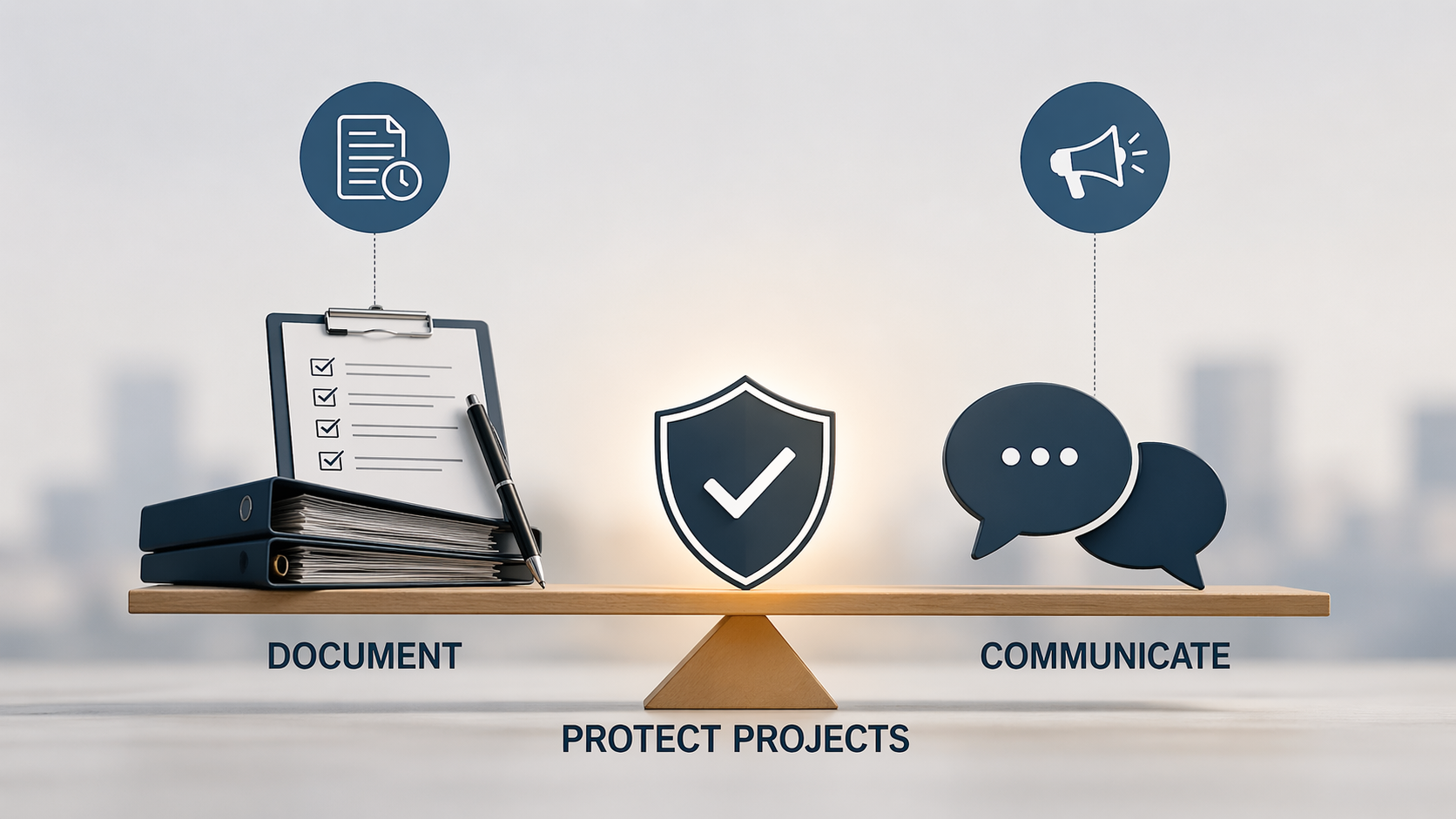
In today’s dynamic and often unpredictable project environments, execution alone is not enough. The real differentiator lies in how well a project is documented and communicated.
Discipline in maintaining records and clarity in communication are not administrative tasks; they are strategic safeguards. They protect entitlement, enhance transparency, and ensure that projects remain resilient even in the face of uncertainty.
In the end, successful projects are not just those that execute well, but those that:
- Document consistently
- Communicate proactively
- Manage risks within the contractual framework
In uncertain times, these practices become your strongest advantage, turning potential disruption into controlled, manageable outcomes.
It is important to understand that projects do not suffer only because disruptions occur. In complex environments, disruptions are often unavoidable. What truly impacts project outcomes is how these disruptions are managed.
Want More Insights?
Explore more articles, case studies, and expert perspectives to stay ahead in AI, data, and digital transformation.
Back to Blogs